What we talk about when we talk about girlhood
A letter to the girl I almost left behind
You asked me, “When did I know I was a woman?” and that’s a question that’s as heavy as a day is long.
The answer lies only in a story about a girl I used to know.
She was just like you.
In many ways, she still is.
See, for her, girlhood never truly ended. It just became layered.
Going deeper and deeper.
Calcifying itself on the way down.
And her memories, while nostalgic, are shaped by rules of survival.
I can still see her legs swinging on the edge of her grandma’s table with Blue Magic and bow bows in her lap on a Sabbath morning before church. For the first day of school, her cousin plaited 1B Kanekalon into rows down her back. The kitchen served as a sacred space for this ceremony of femininity. With hours spent over the sink and under hot combs, stories shared here were full of history and heart, orated with love. And within each part, each twist, each braid, a lesson was embedded.
It would be the first place she learned that pain and beauty were intertwined.
Those Saturday morning church services were where she’d learn to be a lady. Hem to the knee, stockings that mimicked skin, “the higher the heel, the closer to heaven”. In those pews, she’d come to know that appearance was more than reverence to God but esteem in herself.
At home, within closets and bedroom corners, she’d orchestrate her dolls to act out narratives of what she’d seen and heard. Creating worlds where, for once, she controlled the story. Not realizing that her imagination wasn’t just an escape, it was preparation.
Girlhood for her was messy, it was whimsical, but most of all, it was complicated.
In her later days, she’d run home desperate to check her MySpace, feeding her growing desire to be seen, to be chosen, to matter. Her top friends were a collection of the people in her world. Her screen name served as an alternate self, but it was nonetheless the truest reflection of who she was. Her status became a look into the most honest parts of her soul. Red bubbles would be her first confirmation that she belonged.
In the background, bootleg mixtapes rapped lyrics she honestly had no business listening to, absorbing adult emotions before she could fully understand them. Music was emotional education. Portals to worlds she’d never been to and lives she’d never live. Those voices taught her how to feel and defined what was real.
She’d unpack her bag and smooth out the notes that were previously tucked into her locker and then shoved into the crevices of binder folds. They held the secret language of friendship, “Thx 4 coming today. I rly hate this class,” and memorialized her first brushes with puppy love, “I think you’re cute - xo, anonymous.” These notes were an underlying lifeline to social connection, “Vending machines at the bell, k?”
Despite all of this, she still fantasized about being the Black girls she’d seen on TV, living lives she wished were hers. As stylish as Raven Baxter, as quirky as Tia and Tamera, as smart as Moesha, as grown as the women on Girlfriends. To her, real Black girlhood was a possibility… elsewhere. And she longed to one day be her, whoever she was.
That day would never come.
When she graduated to her first acrylic set, she would find her armor and power in every shade of pink and purple OPI she could find in the salon. Quick weaves wielded alchemy she’d never trialed before.
She couldn’t have known then that the magic of girlhood would soon teach her spells she’d never forget.
Spells designed as warning signs for places one should never go.
Sorcery crafted to protect her from a world that wouldn’t.
Wizardry that taught her that who she was without it would never be enough to survive.
There was the incantation to ‘Always be a lady’: Soft. Gentle. Likable. Never gaudy. Well-kept. She never questioned who decided what a lady was, but she always wondered why she looked nothing like her. She learned to shape shift before she had a name for it, and suffered from the exhaustion of constant calibration into different selves for different rooms.
She adopted the ancient mythology that Black women should always be independent and can do for themselves, but never be too masculine or overbearing. Self-sufficient but still malleable. Capable but not threatening. She learned to walk the tightrope of being everything and nothing all at once.
She honed the craft of being “twice as good.” Working harder, being better, to prove her worth without making anyone uncomfortable with her excellence. She kept quiet even when she knew the answer. She asked questions and sought help for things she’d known how to do on her own a long time ago. She softened her talents because who cared about the specialties of a little Black girl anyway?
When her body developed faster than the language to discuss it, she mastered the art of invisibility on her own. Trying hard to heed the warnings about the powers held within her hips. She knew desire was deadly, but soon enough, curiosity would breed danger, and exploration would breed shame.
Girl politics and first heartbreaks would teach her the inevitability of betrayal from the coven. She’d discover that all the magic in the world couldn’t protect you from discovering that love could hurt. She’d learn to cry alone, to perform when she wasn’t fine, to build armor from scar tissue, with one lesson to rule them all: never trust too much.
And to her dismay—when the shimmer tarnished, when she discovered that who she was would always need protection, when girlhood began to ache—is when womanhood began to take shape. The brutally honest acknowledgment that strength was birthed through damage.
Soon enough she’d be instinctively applying lipstick shades and putting on mini skirts she never wanted to wear. She’d work hard to establish herself on her own but would always save a little room for the man she hoped would one day come—and stay. She’d abandon the complexities of community because all she really needed was herself at the end of the day.
One day the little girl inside her slowly faded away. Pushed to the side to make room for the woman she seemingly became overnight. The one they’d told her to be. Her body forced into submission before her mind could process.
Was this what womanhood was designed to be? Emotions buried under busyness, joy hidden under ambition, yearnings surrendered to deflection?
How could she stand face-to-face in front of that little girl with the task of delivering disappointment?
Disappointment in the exhaustion of code-switching so often she forgot which voice was hers. In the weight of carrying everyone’s comfort but her own. In the quiet rage of being told she was “too much” and “not enough” all in the same breath.
What if instead she could tell her that she did not have to live with shame in order to keep herself safe. That she did not have to embody protective mechanisms that would become prisons, or to take on second-guessing as a survival strategy. That she could find a way to craft meaning, define life, in her own way.
What if she could tell her that girlhood still lives—in her laugh, her dreams, her imagination. That in many ways, it never leaves. It’s not a phase you outgrow. Instead it evolves, gently nudging to move through the world with childlike wonder. That she should be herself and herself alone. Not the version they want, but the full, complicated, messy, magical. Remind her that she’s worth defining.
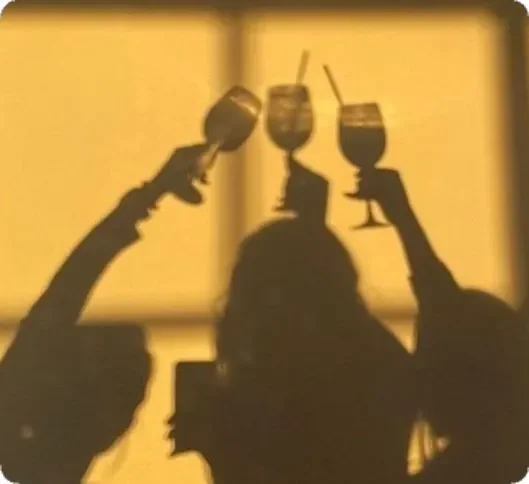
To become the woman I am I had to stop trying to silence the girl. I learned to listen to her in my mirror when I’m getting ready, in my voice when I’m loud about something small, in my fear when I’m unsure of what’s next, in my joy when it all works out.
One day, when you’re grown, you’ll have your own version of this conversation: with yourself, with your daughter, with the next generation. You’ll see her, the girl you were, and understand that she never ended. She echoes. In your walk, in the way you still believe—despite everything, against all evidence—that magic is real.
