

The men I like don’t like locs
A Pleasure to Meet You, Part One: When the world changes before you do
Catching myself in the reflection of the Shake Shack window, I pulled out my phone to snap a quick picture before heading into the train station. “Take another one with me after you add my number.”
The comment happened so quickly that I couldn’t tell where it came from. I chose to keep walking, but once I turned the corner, I smiled the way people do when they crack themselves up with an inside thought. That was lowkey kinda smooth, not gonna lie.
Stepping onto the platform, I posted the picture to my stories, and before I could even make it to Fulton, I had a DM from a guy I’d been flirting with on Instagram for the past few weeks: “stunning 😍”.
This gym-built, chocolate man with a head full of thick, well-moisturized locs was overly my type.
I was kinda surprised I was his.
I never really knew how invisible I was until people actually started noticing me. It wasn’t just Instagram flirting or drive-by compliments at Shake Shack. It was the dramatic increase in Hinge matches, the way conversations were initiated and reciprocated, the comped drinks at parties and on solo dates. It was the noticeably different treatment, with only one real change I could point to: two months ago I’d decided to comb out my locs.
After my first curly cut in ten years, I stood in the mirror carefully fluffing out my curls. Turning my head from side to side, I studied the woman looking back at me. She had a rounder, much softer face than I remembered. The coils draped down into a bang on her forehead. The volume created a perfect halo of hair that hadn’t stretched that tall in years. The dainty length brushed lightly against her shoulders. A few days prior, my dad had said my loose hair made me look more feminine, and watching the woman in the mirror, I could now see what he meant.
I liked this new woman. I didn’t know the world around me would take to her too.
One of the greatest powers of being a Black woman is the way we can conjure a new form simply by using our hair. Each style is a nearly limitless form of expression. Braids, coils, wigs, silk presses, fades, fluffy afros, and locs. We can change the color, length, texture, and the entire architecture of our aura from one swoop of baby hair to the next.
But with every style, every new persona, comes a new perception.
A new expectation.
Suddenly our expression is no longer ours alone. Who we are becomes whatever someone chooses to make of us. Classy, ghetto, baddie, earthy. It assumes our politics, our professionalism, our level of maintenance, our softness, our femininity. Somewhere between what’s expressed and what’s received, a hairstyle becomes a measurement, a litmus test, of how we should be treated.
In the months leading up to my takedown, my algorithm began serving me an influx of popular so-called dating coaches and relationship experts who claimed that, in the dating world, men are hunters. Visual creatures by nature. Judgers of the surface before the depth. They’d preach that appearance was usually the one thing standing in the way of women attracting their ideal person. These “coaches” claimed that hairstyles like locs attracted a specific (typically lower) quality of man. That only a certain type of woman could get away with them without looking unkempt. At the time, I disregarded it as bird-brained level thinking—until more time passed without my locs.
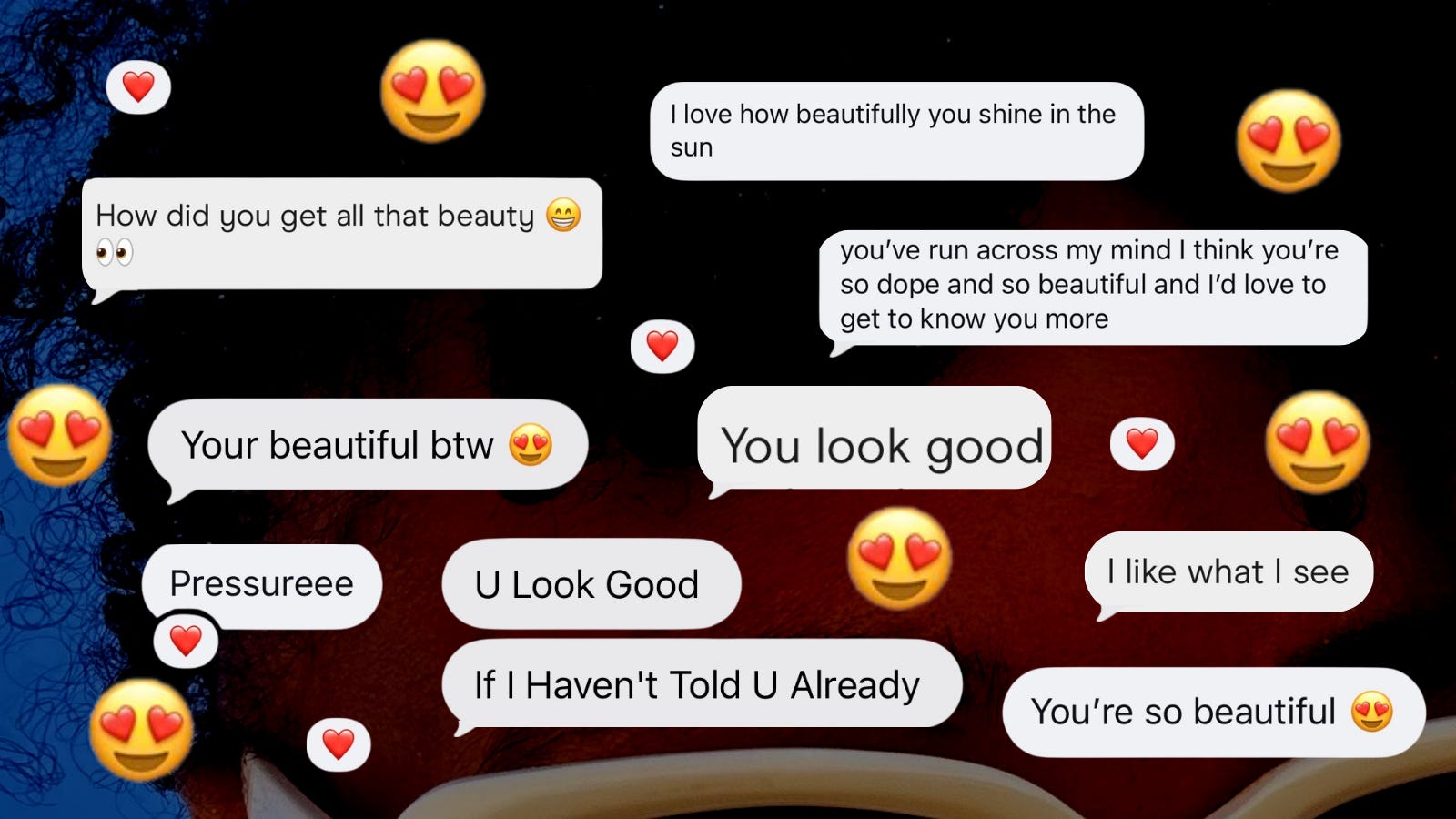
It seemed like overnight the attention started to flood in. Receiving compliments wasn’t completely foreign, but I can’t remember a time with loc’d hair that a man interrupted me mid-sentence to tell me how beautiful I was. Getting likes on stories was one thing, but obvious flirting in my inbox and getting stopped on the street was another. It started to feel like their theories were shifting from pick-me bullshit to almost data-backed proof. The men I like don’t like locs.
That realization laid down a hard weight inside me. Not one of anger or mourning but a concrete ball of matter-of-factness: these men would not be standing in front of me like this if I still looked like that. It made me wonder what other areas of the club I didn’t have access to before this change. Which doors that once seemed locked might jiggle open now if I tried them?
It’s an uncomfortable feeling, being suddenly desirable. Not because it feels bad, but because of the realization that there were criteria that had to be met in order for me to feel this way at all. That an aesthetic choice unknowingly surrendered a part of myself as an entry fee. It’s uncomfortable because what do I do now that I’ve discovered that this option wasn’t unavailable; it simply required a version of me that I hadn’t yet presented?
It’s a feeling that’s as heavy as it is hollow.
The challenge with finally being seen after spending years in obscurity is knowing how temporary it all is. How this kind of desirability can easily be lost. How attention built on the physical evidence of transformation comes with the dread of its reversal. How—as quickly as they’ve come—one wrong cut and color will have them walking right past you again.
I hold this knowledge all while recognizing that nothing has really changed, only the story people have chosen to tell themselves about me on the walk-up. My humor and wit, values and ambitions, intellect and curiosity all remain as intact as ever. My character didn’t shift, just the way I chose to express it.
I know I’m supposed to tell you how disappointed I am at the patriarchal systems that built this beauty standard and vow to curse every man who has now chosen to see me as the human being that I always was. The hardest admission, however, isn’t my lack of rage; it’s that deep down some part of me wanted this.
I made changes because I hoped it would reap a desired outcome.
I wanted to feel different, and I did.
Wasn’t that the whole point?
I would be lying if I said part of “feeling different” didn’t include a slight hope that the world might respond differently too. Now that it has, I’m supposed to pretend the reward means nothing to me because of what I fear it says about who I am. Fear that it’s an indictment of my motivations, values, or self-esteem. Like it’s a crime to enjoy the outcomes of transition. To enjoy finally being seen, desired, liked, accepted.
If the goal of changing my hair was to tell a different story, embody a different aura, why should I be ashamed that I actually enjoy the plot line I’ve placed myself into more than the one I left behind?
When you’ve been taught to look at women who get attention as vain and self-absorbed, you subconsciously trick yourself into building your self-worth around not needing it, making it hard to appreciate or even consider enjoying something you’ve been told never to aspire to.
When you’ve somehow become the very thing you’ve always been shamed out of wanting, you suddenly realize that what was pitched as surface-level conceit is actually deeper than you imagined. That those women, with the pretty faces, and the nice bodies, and the perfect whatever’s, aren’t succumbing to some moral weakness. They, like you, just want to enjoy the party or take a sidewalk picture without an overly eager man inserting himself into their orbit.
What no one stops to tell you is that the high is fleeting. That, after the 50th “you’re beautiful”… “your smile”… “your vibe”… your eyes start to roll to the back of your head at its utterance, and it all starts to sound like nonsense. After you’ve been sold the snake oil of the “glow up”, the “revenge era”, the “confidence” that’s supposed to be waiting on the other side of a transformation, all you’re left with is a habit you have to keep feeding to feel. If you’re not careful, you’ll end up spending more energy chasing that feeling than you ever spent missing it in the first place.
Even if it felt like, for the first time in a decade, I was winning at something I didn’t even know I’d been losing, after a while I realized that it is indeed a game. Especially when it never converts to anything but a new Instagram lurker, an annoying man texting you three times a day asking you if you’ve eaten, and a promise of dates that still never happen. What kind of prize is that?
I suppose the innocence I felt behind this newfound attention was comforting when I didn’t know how to read it, but I know the formula now. I know exactly which version of me gets the drinks bought, the matches, the mid-sentence interruptions. I know exactly what version to lead with to get a reaction and re-up on that high should I ever want another hit.
I don’t know if I do.
I don’t know if obscurity felt better than constantly trying to mentally trick myself into accepting compliments I always knew about myself, but rarely ever heard. Why it leaves me wondering what exactly this version of me holds that others didn’t.
I don’t know if the guy outside Shake Shack would have said anything to the woman with locs or if it’s even the locs at all.
I don’t know what exactly the man in my DMs is reacting to or if two months ago, with a little more confidence in my posture, he would have slid into my DMs all the same.
I don’t even know if the men I like don’t like locs, or if that’s just a false truth I’ll layer onto every man I meet from here on out.
All I know is I’ll forever be running the math on what changed, why now, and if I even like it this way.
